
Heat transport in porous OSG materials: connectivity-controlled and fractional thermal transport near the percolation threshold
Chúc mừng PGS. TS. Arkhincheev Valerii công bố công trình nghiên cứu trên tạp chí quốc tế Materials Chemistry and Physics
Viện Công nghệ tiên tiến (IAST), Trường Đại học Tôn Đức Thắng, xin gửi lời chúc mừng đến PGS. TS. Arkhincheev Valerii về công bố quốc tế mới nhất trên Materials Chemistry and Physics
Bài báo có tựa đề: Heat transport in porous OSG materials: connectivity-controlled and fractional thermal transport near the percolation threshold
Abstract:
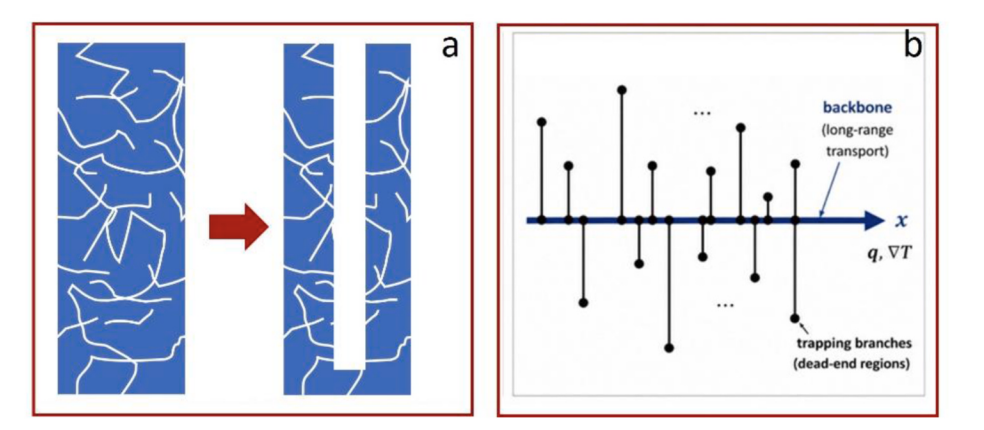
The rapid growth of artificial intelligence and high-performance computing has significantly increased power densities in advanced microelectronic devices, making efficient thermal management an increasingly important challenge. Although thermal conductivity of porous organosilica glass (OSG) materials is commonly described using effective-medium models based solely on porosity, these models fail to explain the pronounced reduction in thermal conductivity observed near the percolation threshold. In this work, we analyse thermal transport by combining fractal surface characterization with a connectivity-based transport framework. Frenkel–Halsey–Hill analysis yields a pore-wall surface fractal dimension of approximately 2.6, indicating a highly developed pore–matrix interface that enhances phonon boundary scattering. A connectivity-controlled transport model is introduced to account for the hierarchical pore architecture and the progressive loss of heat-conducting pathways. The model provides a physical explanation for the nonlinear dependence of thermal conductivity on porosity and reproduces published experimental data over a broad porosity range. The results demonstrate that pore-network connectivity and interfacial fractality, rather than porosity alone, govern thermal transport in porous OSG materials and provide a physically based framework for understanding and predicting thermal conductivity in hierarchical nanoporous dielectrics.
- Log in to post comments