
Estimation based direct simulation on nodal networks: An interpolation-free 7-variable C0-HSDT framework for re-entrant honeycomb auxetic sandwich plates
Chúc mừng TS. Thái Hoàng Chiến công bố công trình nghiên cứu trên tạp chí quốc tế Thin-Walled Structures
Viện Công nghệ tiên tiến (IAST), Trường Đại học Tôn Đức Thắng, xin gửi lời chúc mừng đến TS. Thái Hoàng Chiến về công bố quốc tế mới nhất trên Thin-Walled Structures
Bài báo có tựa đề: Estimation based direct simulation on nodal networks: An interpolation-free 7-variable C0-HSDT framework for re-entrant honeycomb auxetic sandwich plates
Abstract:
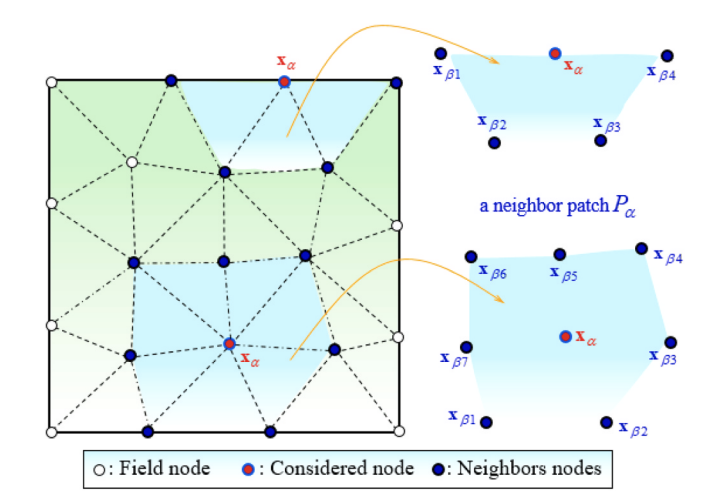
Estimation based direct simulation on nodal networks (EDISONN) method computes spatial gradients directly from nodal values, avoiding interpolated shape functions commonly employed in finite element and meshfree methods. Although previously demonstrated for static analysis of isotropic plates using first-order shear deformation theory, its extension to dynamic analysis of higher order plate formulations and complex auxetic structures remains unexplored. This paper addresses both limitations by introducing the first extension of EDISONN to a C0-type higher-order shear deformation theory of seven variables (C0-HSDT), without requiring a shear correction factor, for free vibration analysis of re-entrant honeycomb auxetic sandwich plates reinforced with graphene nanoplatelets (GNP). The present formulation is entirely free of shape functions, numerical integration and mesh generation. Spatial derivatives are directly computed from neighbor nodal coordinates via a nodal gradient operator and a uniform-average implicit shape function assumption is introduced to ensure balanced nodal contributions within the interpolation-free framework. The sandwich structure consists of a re-entrant honeycomb auxetic core, modeled via cell-wall homogenization, bounded by two GNP reinforced face sheets, whose material properties are captured using the Halpin Tsai model. Numerical studies demonstrate the accuracy and stability of the method for both thick and thin plates. The proposed approach provides a simple, mesh-free and integration-free computational tool well suited to the analysis and design of next-generation lightweight composites in automotive and aerospace engineering. This work thus opens the door to a new family of interpolation-free higher-order plate formulations within the first-order gradient framework.
- Log in to post comments