
Aβ42 Adopts a Stronger Binding Affinity to the Gold Surface than Aβ40
Chúng tôi vui mừng thông báo rằng TS. Ngô Sơn Tùng và ThS. Thái Quỳnh Mai gần đây đã xuất bản công trình của họ có tựa đề "Aβ42 Adopts a Stronger Binding Affinity to the Gold Surface than Aβ40" trên tạp chí The Journal of Physical Chemistry B.
Tóm tắt:
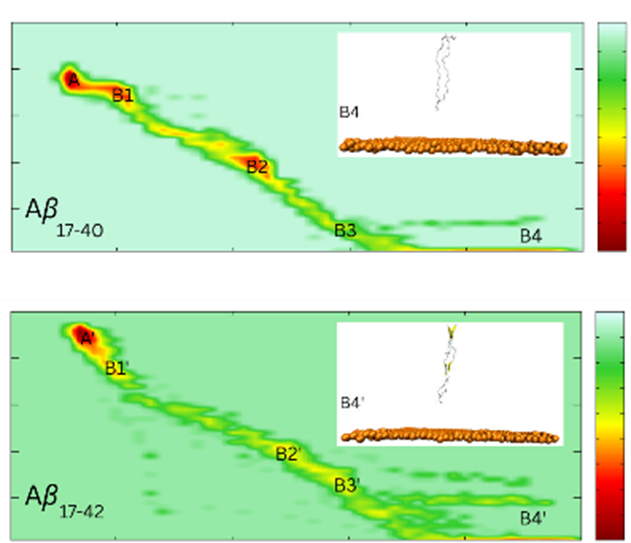
Soluble Aβ oligomers are categorized as major agents of Alzheimer’s disease progression, instead of insoluble fibrils. The binding affinity of Aβ peptides on the gold surface is associated with the biocorona due to the Vroman effect. This phenomenon can be used to screen and/or remove highly toxic amyloid pieces using gold nanoparticles. In this context, the binding process of Aβ40 and Aβ42 dimers to the gold nanosurface was investigated via atomistic simulations, including molecular dynamics (MD) and steered-MD (SMD) simulations. In particular, the obtained results indicate that the Aβ17–42 dimer exhibits a stronger binding affinity to the gold surface than the Aβ17–40 dimer in terms of the rupture force, pulling work, and Jarzynski’s free energy analyses. During this process, the van der Waals (vdW) interaction energy plays an important role, and Aβ17–42 adopts a significantly larger value compared with Aβ17–40. The enlarged interaction is caused by the additional hydrophobic residues at the C-terminus, including Ile41 and Ala42. Furthermore, free energy landscape outcomes demonstrate that Aβ17–42 maintains a rigid β-hairpin during the dissociation process, while Aβ17–40 becomes a random coil.
- Log in to post comments