
Seminar khoa học của TS. Ngô Xuân Kiên và TS. Lê Duy Mạnh
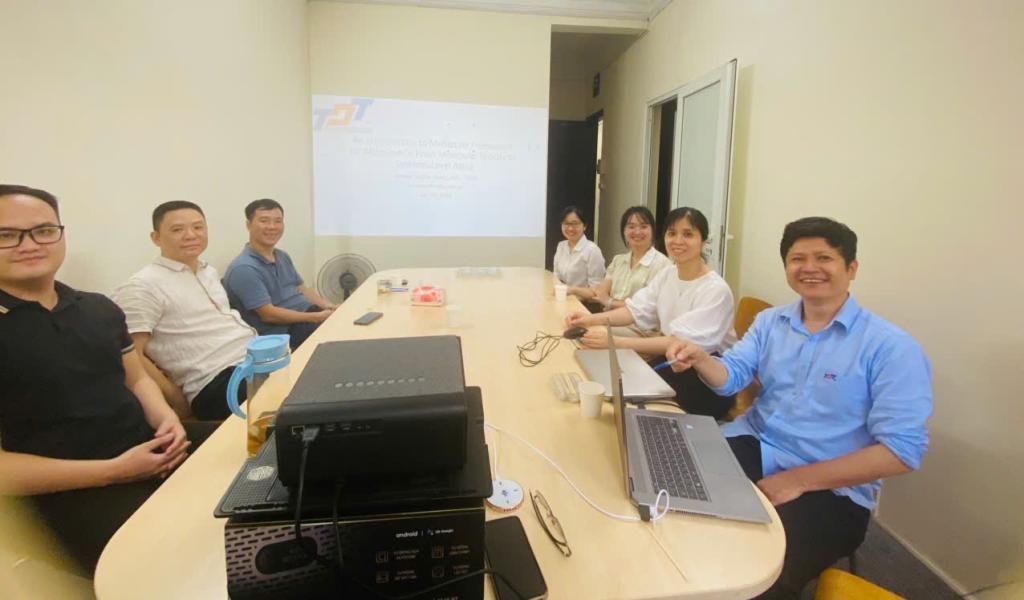
Vào 14h00, ngày 03/04/2026 Viện IAST tổ chức buổi trao đổi học thuật tại Tầng 3, Viện Công nghệ tiên tiến – Văn phòng Hà Nội – 13 ngõ Hàng Bột, phường Ô Chợ Dừa, TP. Hà Nội với nội dung chi tiết như sau:
1/ TS. Ngô Xuân Kiên báo cáo về chủ đề: Watching Proteins Move: From High-Speed AFM to Atomic-Resolution Dynamics
Abstract: Our laboratory integrates experimental imaging, molecular dynamics simulations, and artificial intelligence to advance a new framework for dynamic atomic structural biology. We have recently developed the SimHS-AFMfit-MD approach, which transforms high-speed AFM movies into atomic-resolution conformational ensembles by combining flexible structural modeling, nonlinear normal mode analysis, and all-atom MD simulations.
Proteins are not static objects but dynamic mechanical systems that bend, twist, and reorganize to carry out biological functions. While X-ray crystallography and cryo-electron microscopy provide exquisite atomic detail, they capture only frozen snapshots. Molecular dynamics simulations describe continuous motion but often lack direct experimental validation.
In this seminar, I will introduce the principle of High-Speed Atomic Force Microscopy (HS-AFM), which enables real-time visualization of single proteins in solution with nanometer spatial and millisecond temporal resolution. I will then present SimHS-AFMfit-MD, an integrative framework that reconstructs three-dimensional atomic conformations directly from experimental movies.
Finally, I will highlight selected achievements and ongoing projects from our newly established research group (LISAI-Bio) at IFIRSE, Quy Nhon, Vietnam.
2/ TS. Lê Duy Mạnh báo cáo về chủ đề: An Introduction to Multiscale Computational Framework for Alzheimer’s: From Molecular Toxicity to Systems-Level Aging
Abstract: Alzheimer’s Disease (AD) is investigated through a multiscale computational lens, bridging molecular toxicity, systemic aging, and advanced signal processing.
At the nano-scale, Molecular Dynamics (MD) simulations characterize the "Pore Hypothesis," where Amyloid-beta oligomers form unregulated membrane pores. These pores induce lethal calcium (Ca2+) influx, disrupting endogenous buffers such as Calbindin and misregulating sensors like Calmodulin (CaM).
At the macro-scale, Glymphatic system models simulate how age-related arterial stiffening (dynamic aging parameters) and extracellular space changes impair peptide clearance. This environmental failure facilitates the high-concentration states necessary for microscopic aggregation.
Finally, Empirical Mode Decomposition (EMD) and Transfer Entropy may be employed to analyze nonlinear, nonstationary bio-signals. Integrated with Machine Learning, these methods identify early-warning signatures of neural degradation by linking systemic clearance failure to the breakdown of information flow in the aging brain.
- Log in to post comments