
Seminar on the topic: Advanced Materials and Nanostructures for Energy, Electronics, and Functional Surface Applications
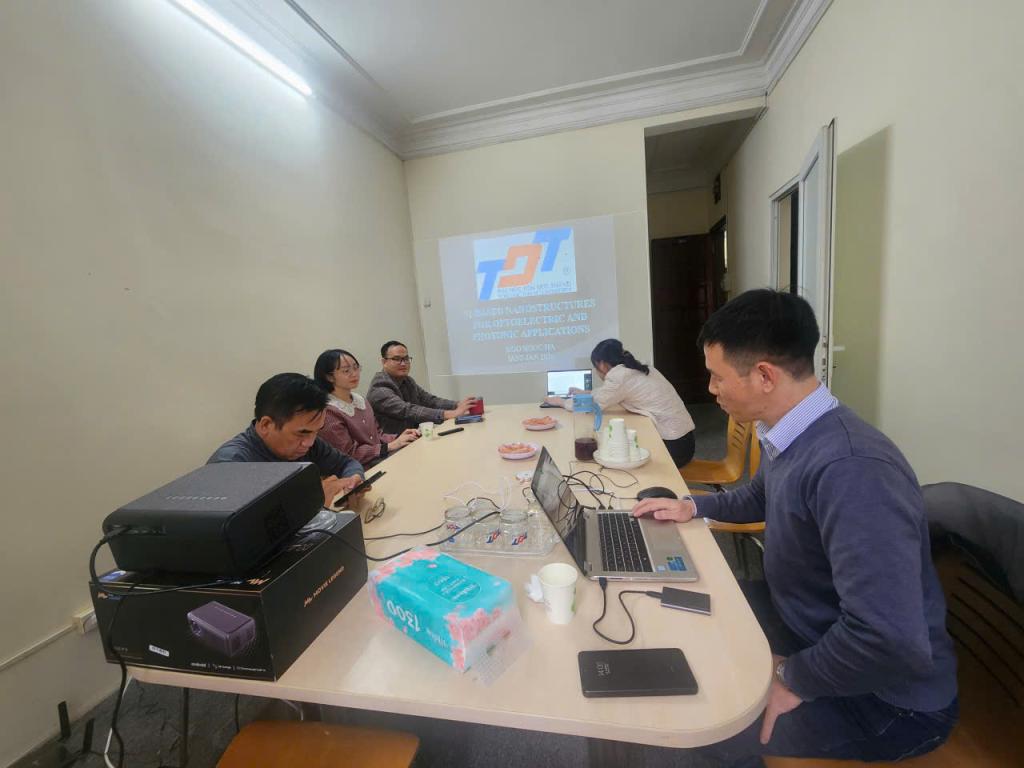
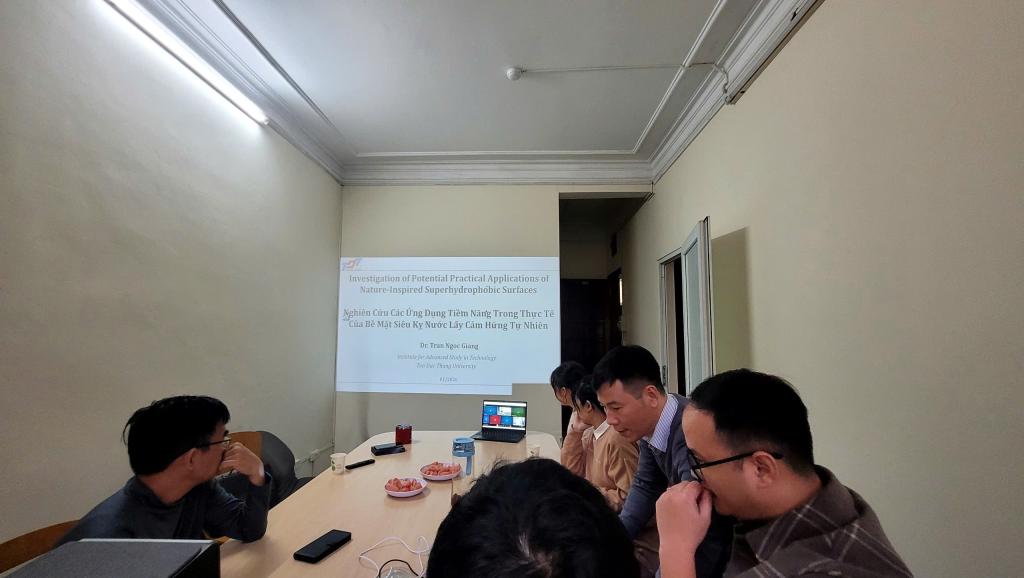
At 2:00 p.m., January 16, 2026, IAST Institute organized an academic exchange session on the 3rd Floor, 13 Hang Bot Lane, Hanoi (Hanoi campus) and the meeting room on the 5th floor of the Library (Tan Hung campus) with detailed content as follows:
1/ Assoc. Prof. Dr. Ngo Ngoc Ha reported on the topic: Silicon-based nanostructures for optoelectric and photonic applications
Abstract:
Silicon (Si) is an essential material in the modern electronics industry due to its environmental compatibility, natural abundance, chemical stability, high achievable purity, tunable electrical conductivity, and suitability for large-scale, cost-effective device manufacturing. However, the continuous miniaturization of electronic components and the rapid pace of technological development have pushed Si-based technologies toward their fundamental physical and performance limits. New approaches to tailor the electrical properties of Si or to integrate photon–electron interactions within a single Si platform may help overcome these limitations. In this presentation, selected nanostructures based on Si and Ge semiconductors are reported and discussed. Their optical, electrical, and optoelectronic properties are investigated through both theoretical and experimental approaches. These studies focus on (i) carrier relaxation processes in Si and Ge nanostructures and (ii) surface structure engineering via chemical etching. The potential applications of these nanostructures in nano-optoelectronic devices, energy conversion systems, and catalytic materials are also proposed.
2/ Dr. Tran Ngoc Giang presents on the topic: Research on Potential Practical Applications of Naturally Inspired Superhydrophobic Surfaces
Abstract:
Superhydrophobic surfaces, inspired by lotus leaves and butterfly wings, have opened up promising application avenues beyond the laboratory. Environmentally friendly fabrication methods, easily implemented at low cost, have been developed by the research group in previous studies. This study synthesizes and evaluates practical applications of superhydrophobic surfaces including self-cleaning, corrosion resistance, antifreeze, and oil-water separation. The study concludes that, with simple fabrication methods and low costs, superhydrophobic surfaces have high commercialization potential for many practical applications, from industry to environmental protection. The main challenges to be addressed in the future are improving mechanical strength and lifespan in harsh environments.
3/ MSc. Nguyen Thi Huyen reports on the topic: Enhancing performance of aluminum anodes with PEO-derived carbon coating for lithium-ion batteries
Abstract:
This study investigates the enhancement of alloying-type aluminum-based anodes for lithium-ion batteries (LIBs), which possess a high theoretical capacity but have yet to see widespread application due to severe structural degradation during cycling. To address this limitation, amorphous carbon coatings were applied to aluminum particles using polyethylene oxide (PEO). The study results demonstrated that the coated aluminum electrode exhibited a significantly higher specific capacity compared to the pristine aluminum electrode. Analyzes indicate that the PEO-derived carbon coating contributed to preserving the structural integrity of the electrode and regulating the lithiation behavior of the active material. This regulation facilitates a gradual activation of the electrode material over the duration of the electrochemical measurements, therefore improving its overall performance.
- Log in to post comments