
Two IAST Scientists Take Part in International Studies on Public Health Challenges
Ho Chi Minh City, October 2026. The world faces a tangle of health challenges, from the resurgence of measles among young children and the mental health and obesity problems affecting young people, to the burden of chronic disease and antimicrobial resistance in an ageing population. These issues are reflected in five international studies published in September and October 2026 in Nature Medicine (impact factor: 52.5), The Lancet Public Health (impact factor: 26.5), The Lancet Child & Adolescent Health (impact factor: 13.4), and The Lancet Regional Health – Western Pacific (impact factor: 9.4). Two scientists from the Institute for Advanced Study in Technology (IAST), Ton Duc Thang University (TDTU), Dr. Nguyen Hoang Long and MSc. Ngo Thi Tam, participated in these studies as co-authors.
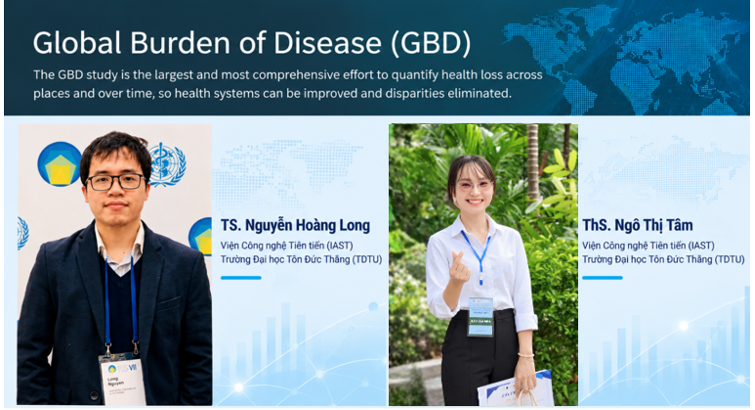
The studies were carried out within international scientific collaboration networks and mainly drew on data from the Global Burden of Disease (GBD) study, with the participation and support of the Institute for Health Metrics and Evaluation (IHME) at the University of Washington, United States, and many other research organizations worldwide. By synthesizing large-scale epidemiological data and applying statistical analysis methods, these works help clarify changes in disease patterns, health inequalities, and public health priorities in the coming decades.
A message that runs through the studies is that the public health gains already achieved must be sustained, even as new healthcare needs continue to emerge. The study in Nature Medicine found that the number of measles cases among children under 5 worldwide rose by 40.4% between 2019 and 2023, reaching about 15.6 million cases, while coverage of the first measles vaccine dose declined from 83.6% to 81.0%. Meanwhile, the study in The Lancet Public Health recorded an increase in the number of people with major oral diseases from 3.62 billion to 3.73 billion over the same period, even though the age-standardized prevalence fell slightly by 1.55%. These results point to the need to strengthen prevention programs, maintain immunization, and expand access to essential healthcare services. As people move into adolescence and young adulthood, health challenges continue to change. An analysis of 44 countries and territories in the Asia-Pacific region, published in The Lancet Child & Adolescent Health, showed that noncommunicable diseases accounted for 64.8% of the total disease burden among those aged 10-24 in 2023, with mental health a prominent concern, while overweight and obesity rose in all surveyed countries. These findings underscore the importance of combining infectious disease prevention with comprehensive healthcare that emphasizes nutrition, mental health, and the prevention of risk factors from the earliest years of life.
The health landscape shifts further as populations enter adulthood and older age, particularly in countries undergoing rapid epidemiological transition, such as Vietnam and other Southeast Asian nations. The study in The Lancet Public Health on causes of death in 11 ASEAN countries showed that neonatal disorders predominate in the first year of life, road traffic injuries are a major cause of death among adolescents and young adults, and ischemic heart disease, stroke, and diabetes become leading causes from middle age onward. In 2023, life expectancy at birth in the region reached 70.1 years for men and 76.2 years for women, although considerable differences remain between countries. Alongside the burden of chronic disease and population ageing, antimicrobial resistance is posing additional challenges to health systems. The study in The Lancet Regional Health – Western Pacific estimated about 1.15 million deaths associated with antimicrobial resistance in the Western Pacific region in 2021, of which 248,000 were directly attributable to resistance. Notably, between 1990 and 2021, resistance-associated deaths among children under 5 fell by 87.3% but rose by 88.9% among people aged 70 and over, and such deaths are projected to reach 1.84 million per year by 2050. Taken together, the results show that protecting population health requires a life-course approach that combines early prevention, chronic disease control, rational antibiotic use, and stronger health system capacity, grounded in up-to-date scientific evidence.
In joining these international research networks, Dr. Nguyen Hoang Long, a member of the IAST Science and Training Council, brings experience in public health, epidemiology, and health data analysis, with more than 120 publications indexed in Web of Science, an H-index of 30, and a current role as Academic Editor of PLOS ONE. Working alongside him is MSc. Tam, a research assistant at IAST, whose research focuses on clinical epidemiology, community health, and the application of data analysis methods in biomedicine. Taking part in the GBD studies gives the two scientists an opportunity to exchange expertise, gain access to modern research methods, and broaden collaboration with international research groups. For the Institute for Advanced Study in Technology and Ton Duc Thang University, these activities align with the strategy of developing interdisciplinary research, strengthening academic integration, and linking data science with biomedicine and public health. By maintaining and expanding international collaboration networks, IAST aims to build its research capacity, contribute to scientific knowledge, and gradually advance research with practical value for healthcare in Vietnam.
- Log in to post comments