
Seminar on the topic: Fabrication and applications of advanced microstructured materials
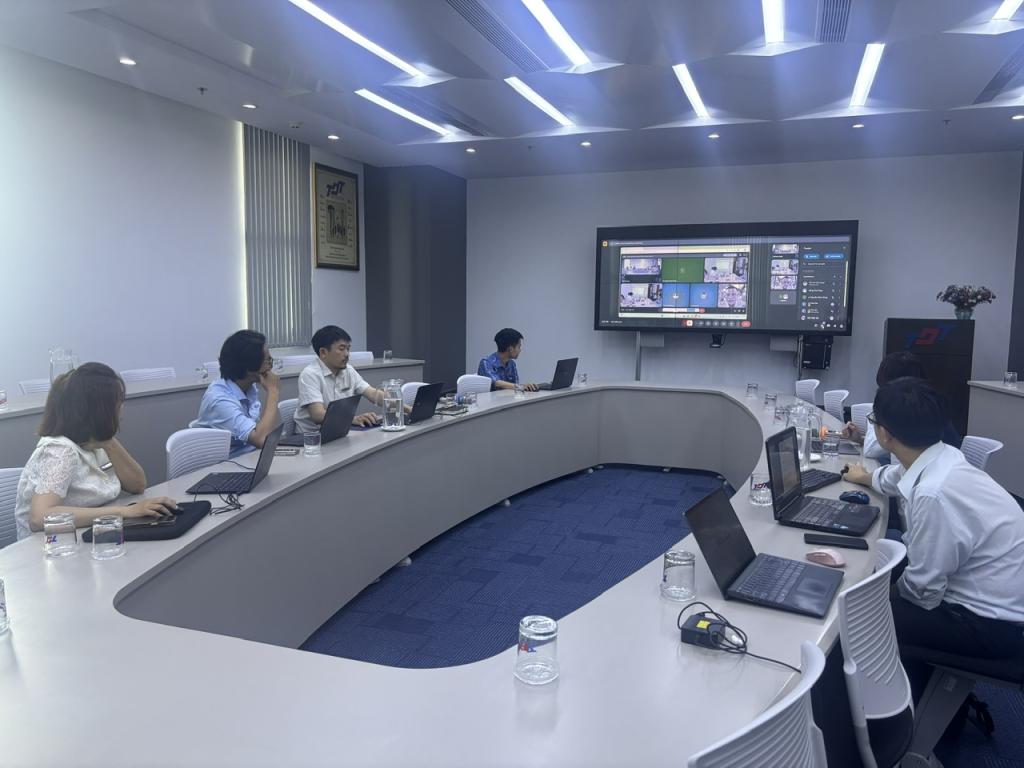
At 2:00 PM on March 20, 2026, the IAST Institute will hold a seminar at the Meeting Room, 5th Floor, Library - Tan Hung Office and 3rd Floor, IAST - Hanoi Office - 13 Hang Bot Alley, O Cho Dua Ward, Hanoi City, with the following details:
1/ Dr. Lo Nu Hoang Tien will present on the topic: Photothermal superhydrophobic coatings based on wrinkled mesoporous carbon for efficient anti-icing and deicing.
Abstract: Maintaining long-term, durable icephobicity under extreme conditions such as ultralow temperatures and high humidity remains a significant challenge. In this study, a photothermal, superhydrophobic coating based on wrinkled mesoporous carbon (WMC) was developed to achieve efficient anti-icing and deicing. The coating was fabricated by spray-coating a mixture of WMC and polydimethylsiloxane (PDMS) resin onto a PDMS-pretreated Al substrate. The resulting surface exhibits remarkable superhydrophobicity, with a water contact angle of 163° and roll-off angle of 2.8°. Under 1-sun illumination, the surface temperature rapidly increased to 76.5 °C, demonstrating the superior photothermal effect. The coating effectively delayed the freezing of water for up to 120 min at −15 °C, significantly influencing conventional surfaces. The photothermal de-icing capability of the coating was assessed by monitoring the melting of frozen water under simulated sunlight. The frozen droplets on the coated surface melted completely within 5 min 39 s, and the melted water easily rolled off. The outstanding anti-icing and de-icing performance of the coating is attributed to its hierarchical micro/nanostructure, which minimizes ice adhesion, and the superior photothermal efficiency of the WMC. This study highlights the potential of WMC-based photothermal, superhydrophobic coatings as highly effective and scalable solutions for anti-icing applications.
2/ Dr. Tran Van Loi reports on the topic: Effectiveness of an additively manufactured porous layer in dissimilar solid-state bulk joining of additively manufactured maraging steel and conventional AISI410 steel.
Abstract: Solid-state bulk joining of additively manufactured maraging steel and commercially available martensitic stainless steel (AISI410) specimens in a cylindrical shape is accomplished through electrically assisted pressure joining (EAPJ). The cylindrical maraging steel specimen is fabricated to have a porous layer on the joining side by selective laser melting additive manufacturing. During EAPJ, the porous layer, which serves as an interlayer with locally increased electrical resistance due to geometrically induced defects (pores), significantly and locally increases the maximum temperature while the joining load is dramatically decreased. The microstructure evolution suggests that grain refinement occurs on both the maraging steel and AISI410 sides due to recrystallization. The high residual stress induced during additive manufacturing of maraging steel specimens is significantly released during EAPJ. Martensite formation in the AISI410 steel and the reverted austenite in the maraging steel are characterized by the grain average image quality. Tensile tests show that the fracture always occurs in the transition region between the heat-affected region and the unaffected base metal region. The present study demonstrates that bulk joining of additively manufactured components and conventional components can be more easily and effectively achieved with the use of an additively manufactured porous layer, even for dissimilar material combinations.
3/ Dr. Tran Ngoc Giang reports on the topic: Sustainable and Scalable Fabrication of Fluorine-Free Superhydrophobic Ceramic Surfaces via Laser Texturing and Silicone Oil Heat Treatment.
Abstract: Superhydrophobic (SHPo) ceramic surfaces with water contact angles exceeding 150° are highly desirable for demanding applications in aerospace, optics, biomedical devices, and harsh environment engineering due to their potential for self-cleaning, anti-icing, corrosion resistance, and reduced fluid drag. However, their widespread practical adoption is often hindered by process complexity, concerns over mechanical and thermal durability, and the prevalent reliance on persistent, bioaccumulative, and toxic fluorinated compounds, which pose significant environmental and health risks. In this work, we present a rapid, sustainable, and scalable fabrication strategy to achieve robust, fluorine-free SHPo on technical ceramics. By combining direct nanosecond laser texturing with a rapidly, eco-friendly post-process, namely a 10-minute heat treatment using non-toxic silicone oil, we successfully fabricate SHPo surfaces on single-crystal sapphire (Al2O3) and titanium dioxide (TiO2) substrates. This simple thermal treatment accelerates the adsorption of hydrophobic organic groups onto the laser-activated ceramic surface, creating a durable, low-surface-energy layer without hazardous chemicals. We demonstrate that the laser areal fluence, a composite parameter, serves as an effective tool for precisely tuning surface morphology and, consequently, the water adhesion behavior, from low-adhesion, rolling states to high-adhesion, pinned states on these inherently hard and inert materials. This capability to engineer differential adhesion on a single substrate opens avenues for advanced applications in controlled droplet manipulation and microfluidics on ceramic platforms. Furthermore, the stability of products was evaluated after 3 years in ambient air and the excellent performance of SHPo ceramic surface was demonstrated through the water bouncing effect and the self-cleaning effect. This research provides a versatile, environmentally benign, and industrially scalable pathway for manufacturing multi-functional SHPo ceramics.
- Log in to post comments